Showing posts with label tax. Show all posts

Monday, June 13, 2011

The Facts about the Alternative Minimum Tax

The Alternative Minimum Tax was created in 1969 to prevent 155 extremely wealthy taxpayers from using deductions and credits to avoid paying any federal income taxes. Yet as Reason columnist and Mercatus Center economist Veronique de Rugy explains in her latest appearance on Bloomberg TV, today the tax overwhelmingly impacts non-millionaires living in just a handful of states. By separating economic myths from economic realities, de Rugy explains the facts about the Alternative Minimum Tax.

Sunday, June 12, 2011

Video: Herman Cain on the "Fair Tax"


HERMAN CAIN ON "FAIR TAX" 110611 The term "fair tax" is propaganda. It's a transfer of tax reporting from those with a paycheck to small businesses that provide services. Cut govt spending by 50%, no tax on services.

I like the idea of the "Fair Tax", but there's a huge constituency that will guarantee that it never goes into effect. That constituency is the Internal Revenue Service (IRS). I just don't see how you fire everyone at the IRS.

Thursday, April 21, 2011

Petition to Redistribute GPA Scores


From the YouTube description:
Many students believe that it is moral to confiscate money from hard-working Americans and entrepreneurs and give it to those who didn't earn it, yet don't support the same philosophy when it is applied to their GPA scores.

Monday, April 18, 2011

Taxes: Have You Paid Your Share?

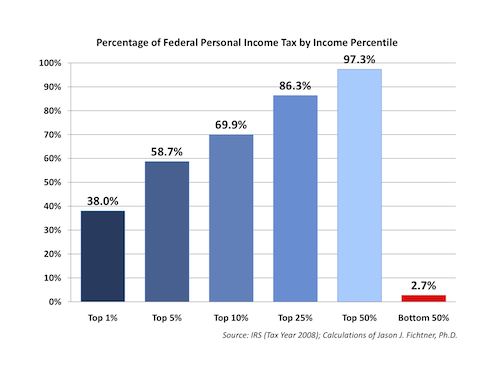
The chart above comes from the Mercatus Center at George Mason University. It illustrates the breakdown of federal personal income taxes:
This week, Mercatus Center Senior Research Fellows Veronique de Rugy and Jason J. Fichtner chart the fairness of the biggest source of federal revenues – the federal income tax. This bar graph uses data from the Internal Revenue Service to break down total federal income tax revenues by the earnings percentiles of the Americans who paid them. The top earning 1% of Americans (or 1.4 million returns) paid 38% of taxes while the Americans at the lower half of the income spectrum (or 70.0 million returns) paid 2.7% of total federal personal income taxes.

According to the Tax Policy Center, this tax season, an estimated 45% of tax units will pay no federal income taxes. In 2009, federal non-income taxpayers were distributed throughout the earnings spectrum, with 26.3% of tax returns reporting less than $10,000 paying no income tax, 29.1% of those making between $10,000 and $20,000 paying no income tax; the remaining 44.6% of Americans not paying income taxes were distributed throughout all cash income levels.

In fact, taxpayers with the highest 400 AGIs (who made on average $345 million in 2007, the majority of which came from capital gains which are taxed at a maximum rate of 15%) were taxed at an average federal income tax rate of 16.62 percent, with effective tax rates within this group ranging from 0% to 35%.

These statistics signal a tax system that is not only progressive, but one that is convoluted and unfair.

Tuesday, March 22, 2011

Former State Auditor, Claire McCaskill, is Audited

Incumbent Senator Claire McCaskillImage via Wikipedia
Earlier this month I noted that Claire McCaskill (D-MO) had been caught self-dealing by using tax payer money to lease a private jet from a company that she owns. Now things have taken a turn for the worse for Missouri's senior senator. Mark Hemingway in The Weekly Standard notes that Sen. McCaskill Failed to Pay $287,000 in Property Taxes on the Aircraft:
Ah Senators, they're just like you and me! Who among us hasn't forgotten to pay hundreds of thousands of dollars in taxes on our private aircraft...

Tuesday, January 18, 2011

Comprehensive List of Tax Hikes in Obamacare

Americans for Tax Reform has compiled a comprehensive list of tax hikes in Obamacare:
...the U.S. House of Representatives will be voting on an historic repeal of the Obamacare law. While there are many reasons to oppose this flawed government health insurance law, it is important to remember that Obamacare is also one of the largest tax increases in American history. Below is a comprehensive list of the two dozen new or higher taxes that pay for Obamcare’s expansion of government spending and interference between doctors and patients.
Remember to call your Representative and ask them to vote to repeal Obamacare.

Sunday, January 9, 2011

It's Time to Start Taxing Non-profits

Don Surber suggests that we should start taxing non-profits. Considering that most non-profits inside the beltway lobby government, I think he makes a forceful case with this simple sentence: "I suggest we start calling these lobbying groups exactly what they are: tax-exempt lobbyists."

Tuesday, January 4, 2011

Census Proves that Americans Like Lower Taxes

Over the past ten years, Americans voted with their feet as they left states with high taxes and moved to states with lower taxes (h/t Greg Mankiw):
...growth tends to be stronger where taxes are lower. Seven of the nine states that do not levy an income tax grew faster than the national average. The other two, South Dakota and New Hampshire, had the fastest growth in their regions, the Midwest and New England.
Clearly, lowering taxes is pro-growth.

Saturday, December 18, 2010

Breaking Down the Tax Vote

Jay Cost in The Weekly Standard on Breaking Down the Tax Vote:
Last night's vote in the House of Representatives to extend the current tax rates marked an ironic end for the 111th House of Representatives. As unpopular as she has become, House speaker Nancy Pelosi did an extraordinary job of holding her caucus together for tough votes. However, last night the Democrats did something they hardly ever did during her four-year tenure as speaker: they split almost down the middle over the final tax provision. The final roll call vote had 139 Democrats voting in favor of the package while 112 voted against. From a Republican's perspective, this is exactly what you want to see. Roll call votes that unite your side and divide the opposition are just what you want from a legislative perspective, and that's exactly what the vote last night produced.

Friday, December 17, 2010

Megan McArdle asks a Direct Question

Blogging at The Atlantic, Megan McArdle asks a direct question about the health insurance mandate. Her question is in the context of the court challenge to the healthcare bill that's being heard in Florida:
I don't know the answer to this question, so I'm genuinely asking: would it be constitutional to effectively declare that the nation's health insurers are branch offices of the Internal Revenue Service?
If the health insurance mandate is a tax, then health insurers that collect revenue under that mandate are effectively tax collectors. Does the healthcare bill turn health insurers into quasi-tax collectors and is that Constitutional?

Thursday, December 16, 2010

Throwing Sand in the Empire's Machinery

Jim DeMint headshotImage via Wikipedia
The Hill is reporting that the GOP will paralyze Senate floor with reading of 1,924-page spending bill:
Republicans will paralyze the Senate floor for 50 hours by forcing clerks to read every single paragraph of the 1,924-page, $1.1 trillion omnibus spending bill.
Senator Jim DeMint (R-SC) is behind this effort and deserves to be rewarded if it comes to pass. My recommendation is a penny a page. Please consider donating $19.24 to DeMint during the reading of the bill.

Given the arrogant truculence of this lame duck session of Congress, I believe the GOP's best strategy is to simply gum-up the works. Doing so may prevent action on other pending legislation including the so-called "DREAM" Act. And while conservatives and the GOP will be criticized for such intransigence, the fact remains that the Democrats had all year, both houses of Congress, and the Presidency and choose not to pass a budget for fear of greater losses this past November.

Saturday, December 11, 2010

Obama's Tax Hike Extravaganza

Each tick of the clock brings us closer to the expiration of the Bush tax cuts. Rush Limbaugh has come out against the compromise bill as has far-left Senator Bernie Sanders. President Obama has unwittingly united the left and the right, but what's gnawing at him is the ghost of George W. Bush.

Having won the presidency in 2008 largely by vilifying Bush, Barack Obama is now facing the reality that Bush's tax cuts will become Obama's Tax Hike Extravaganza at the stroke of midnight that begins the new year. And Obama will receive the blame because of his failure to lead on Tuesday, his abdication on Friday, and the fact that Democrats have controlled both houses of Congress and the Presidency for the past two years. Thus the nation plods, zombie-like, toward the economic catastrophe of higher taxes for all.

Thursday, December 9, 2010

When Property Prices Collapse, so will Local Tax Revenue

Bloomberg is reporting that Home Values May Drop by $1.7 Trillion:
U.S. Home values are poised to drop
by more than $1.7 trillion this year amid rising foreclosures
and the expiration of homebuyer tax credits, said Zillow Inc., a
closely held provider of home price data.


Published with Blogger-droid v1.6.5

Of Tax Rates and Policy

Earlier this week, Cubachi noted that not all conservatives are sold on the tax cut deal:
Conservatives, tea partiers, and republicans have worked diligently and effectively to give the republican party its larget house win in years. We now get an extension of the Bush tax cuts for two years, and funemployment… I mean unemployment checks for 13 months. So the unemployed will have more fun collecting money from those of us in the productive sector. Has the republican leadership in the House put up a fight?

Representative Michele Bachmann and Senator Jim DeMint have voiced their concerns about this deal, while DeMint has come outright against the deal.
Cubachi also points to criticism from Jimmie at the Sundries Shack who thinks the GOP’s tax deal isn’t a very good for us or the economy:
The overall thought is that there was no chance that Republicans could make the current tax rates permanent, and they managed to extract a couple smaller temporary cuts such as a one year payroll tax holiday of 2 percent out of a clearly unwilling President. They get a tailor-made issue to use in 2012 and we get a little tax cut.
Jimmie then goes on to point out several problems with the tax cut compromise. I'm going to highlight only the two (of four) that I want to comment on:

...the paltry one-year, two-percent cut to individual payroll taxes (businesses will still have to pay the full 6.2 percent) is essentially another stimulus check. The only difference is that this money is coming out of the Social Security system, which is already running wildly out of control.
As Ace of Spades pointed out, the White House has said:
[...] The tax cut legislation would provide for a transfer of General Revenues to the Social Security Trust Fund, ensuring no negative impact on Social Security solvency.[...]
Got that? Instead of using Social Security funds to feather bed the General Revenue account as has been done since LBJ, money's going to flow in the other direction. I believe this is the first time that we are planning for general revenue money to be moved to move the non-existent "trust fund". Perhaps this will be the beginning of the realization that Social Security is an unsustainable Ponzi scheme.

The other point that Jimmie makes and I want to comment on is:

...the tax rates will stay put for two years. In the short term that’s a good thing. But for a small business owner, or any business owner for that matter, the uncertainty over how much much money they’ll have to hire employees hasn’t really changed.
I think he over plays the uncertainty issue. The only way that there would now be certainty is if Congress had acted with enough time for businesses to adjust their end of year planning. Because we're running out of time for a compromise right now, uncertainty is at the forefront of everyone's mind; however, this is because Congress chose not to act last spring or summer. In fact, I've already opined about the perversion of incentives that uncertainty creates. It is an issue.

And the idea that there would be certainty if the tax cuts were "permanent" ignores the fact that tax rates have changed often over the years. The expiration of a tax agreement functions more as a scheduling tool for tax discussions which most politicians want to defer. The mistake this time around was deferring them as late as Congress has. I personally think that a two or four year expiration on tax cuts is a feature, but I'll grant that business owners would be better able to plan if that expiration occurred when no new tax legislation is passed six months prior to the actual expiration date. In other words, force Congress to act (or not) in June.

The reason I like the sunset provision is that it requires Congress to reconsider what our tax policy should be. I think there's value in simply having that discussion periodically. From a political stand point, there's value in scheduling tax rate reviews because it's (usually) a winning issue for conservatives, but there are process advantages as well. Tax debates are inevitably contentious; therefore, they take time away from all the liberty crushing bills our betters in DC would rather be working on. But there's also non-political, non-partisan value in the country contemplating and then affirming what our tax policy will be for the next few years.

I see a lot of value in sunsetting the federal code. In fact, I'd like to see (more or less) all laws sunset for the same reasons mentioned above. If you think this is unreasonable, you need to consider the fact that not doing this means that the body of rules, regulations, and legislation that we have will continue to snowball out of control. Obviously, a four year review is unreasonable for reviewing everything (I'm thinking 20 or so years) and such reviews would have to be staggered so the work was evenly distributed over time.

Wednesday, December 8, 2010

The Schooling of Mary Landrieu

Mary Landrieu, LouisianaImage via Wikipedia
Don Boudreaux of Cafe Hayek takes Sen. Mary Landrieu (D-LA) to the woodshed: "how difficult can it be to cut $46 billion in spending from a $3.8 trillion budget? Is it really so difficult, so cruel, so illiberal to reduce federal-government spending by 1.2 percent?"

Sunday, December 5, 2010

Senate Rejects the 2010 Obama Tax Hike

The Hill reports that Republican Senators were joined by a few Democrats and successfully rejected the 2010 Obama tax hike in a rare Saturday session:
Voting nearly identically, the Senate twice failed to meet a 60-vote threshold necessary to move forward on both proposals. Meeting in a rare Saturday session after agreements fell through for a Friday vote, the results were widely expected. They were also somewhat premature, as the White House is still negotiating with congressional leaders on an alternative compromise proposal.
Forbes reported on Friday that Congress basically has to act by December 15th. If they don't, then there's a good chance that we'll see a stock market sell-off as investors take their profits now under a more favorable tax rate. That gives Congress about ten days to cobble something together.

While I think it's likely that a compromise will be worked out, I will not be surprised if one isn't and the Bush Tax Cuts expire only to be remembered in the 2012 campaign season as the 2010 Obama Tax Hike.

Wednesday, December 1, 2010

The Obama Tax Hike

The Wall Street Journal is reporting that GOP Senators have threatened to block Legislation until the Bush tax cuts are extended:
"While there are other items that might ultimately be worthy of the Senate's attention, we cannot agree to prioritize any matters above the critical issues of funding the government and preventing a job-killing tax hike," all 42 GOP senators wrote in a letter to Majority Leader Harry Reid (D., Nev.). The 42 signatures are more than enough to block action on almost any item he wishes to advance.
This is exactly what I want to see. Kudos to the Senate Republicans for holding the line on the Bush tax cuts. I do not expect Democrats on the Hill or President Obama to back down on their absurd proposal to raise taxes on America's most productive citizens; therefore, I expect the Bush tax cuts to expire. Of course, that requires all 42 Republican Senators to hold the line. They will be rewarded in the 2012 election cycle when the expiration of the Bush tax cut is remembered as the Obama Tax Hike.

Previously:

Tuesday, November 23, 2010

Higher Taxes and More Spending

Stephen Moore and Richard Vedder in The Wall Street Journal: Higher Taxes Won't Reduce the Deficit:
Using standard statistical analyses that introduce variables to control for business-cycle fluctuations, wars and inflation, we found that over the entire post World War II era through 2009 each dollar of new tax revenue was associated with $1.17 of new spending. Politicians spend the money as fast as it comes in—and a little bit more.
 Nothing short of a balanced budget amendment will fix this problem.

Friday, November 19, 2010

The Coming Tax Storm

Pajamas Media reports on the taxes coming in 2011:
Focus instead on the simple fact that the last budget that a Republican Congress had control over had a deficit of approximately $162 billion dollars — a large number to be sure, but not so large that the Democrats and our “progressive” president couldn’t expand it in under two years by nearly a factor of ten. Under the Obama administration and with the Democrats in complete and total control, we have record debt, record deficits, record unemployment, record underemployed, record foreclosures, record bankruptcies, and soon, record tax increases.

Monday, November 15, 2010

The Certainty of Tax Accounting

Over at the lefty Mother Jones, Kevin Drum is bewildered by the uncertainty meme:
The only significant real uncertainty that American businesses face right now is financial uncertainty: that is, whether there will be enough consumer demand next year to justify hiring more workers and buying more equipment today. PPACA and carbon taxes rank very far down the list.
Elsewhere, Kevin acknowledges that Congress really should've dealt with the Bush tax cuts before now; however, I don't think he understands why those tax cuts have introduced so much uncertainty.

I was self-employed for a few years. My accountant repeatedly advised me to "accelerate my expenses and defer my income." In practical terms, this meant that I'd try to make big purchases before the end of the year and I'd hope and pray that my clients would send the check for my December work the slowest way possible since the IRS doesn't require you to recognize revenue until it arrives in your mailbox. My clients, of course, wanted to realize the expense of paying me in the current year, but I didn't want to realize the revenue until the next year. My clients were accelerating their expense so that their adjusted revenue would be lower, thereby lowering their tax obligation. I wanted to defer that income so that I wasn't pushed into a higher tax bracket or so I could benefit from a lower tax bracket the following year.

All companies play this game. Some have entire accounting departments devoted to it.

The Bush tax cuts are set to expire January 1st. Obama does not want to extend the Bush tax cuts for people making over $250,000. I'd guess that most of those people making north of $250k are small business owners. Now the rule of thumb is "accelerate your expenses and defer your income," but that no longer works in the Twilight Zone of Obamanomics. If you expect your taxes to be higher next year and you know that the tax brackets under $250k aren't going to have higher rates if Obama has his way, two things that those $250k+ small business owners understand, then you should defer your expenses until next year and accelerate your income. That's precisely the opposite of the rule of thumb.

If the Bush tax cuts for people making over $250k are extended, then businesses would know how to handle their accounting: accelerate expenses and defer income. If the Bush tax cuts simply expire, then everyone can figure out what to do for their individual circumstance. The same applies for the Obama plan of only extending the tax cuts for people making under $250k; however, by promising lower rates for people under $250k, more small business owners will be inclined to defer expenses until next year.

The upshot of all of this is that the uncertainty that alludes Kevin Drum is what next year's tax rates will be. Once that's known, everyone will know whether or not income and expenses should be deferred or accelerated. Everything will become clear once Congress acts (or doesn't), but because of the uncertainty business decisions about income and expenses have been much harder to make this year. FWIW, if the left is right and the underlying economy is good, then businesses will ramp up early next year regardless of what Congress does... just in time for the Republican controlled House to claim credit.

Disclaimer: I'm not a tax accountant. Tax law is complicated and everyone's situation is a little bit different. Contact a tax professional for guidance on your tax obligation.